
Junk removal laws and permits in Hawaii: what homeowners should know
By Nadia Ferraro · Updated 2026-07-09
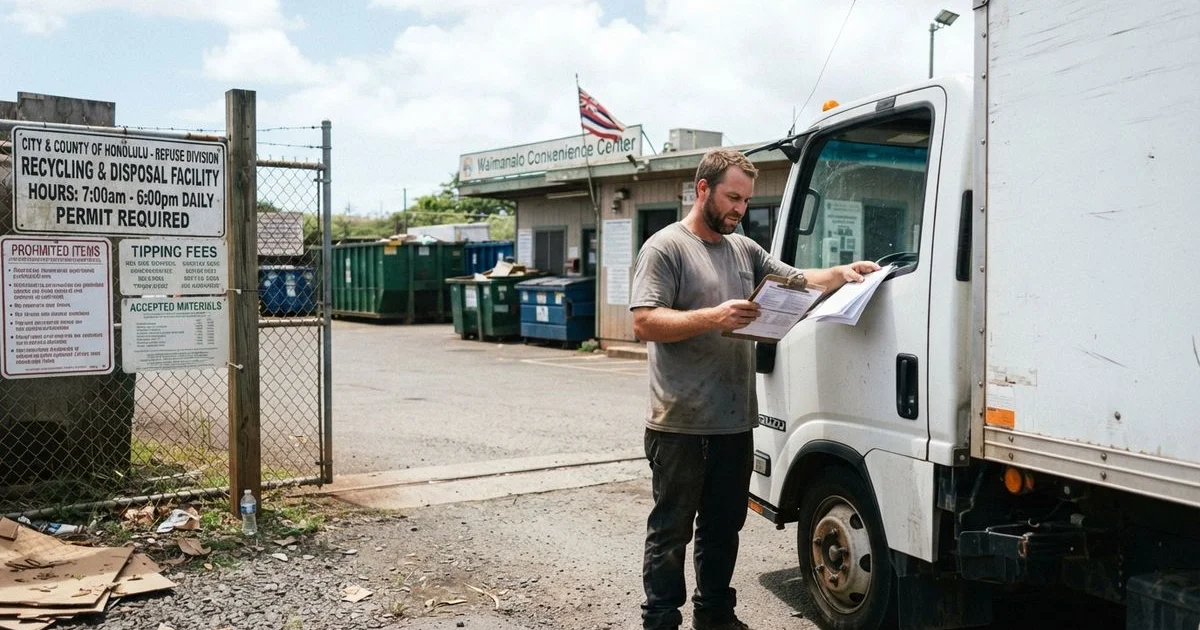
Hawaii’s junk removal rules are less about needing a permit for a standard pickup and more about what happens if items end up somewhere they should not. Understanding where the real legal exposure sits, for you and for the company you hire, helps you avoid an avoidable problem.
This guide is general information, not legal advice. For a specific legal question, consult a licensed attorney or the relevant Hawaii state or county agency.
When you do not need a permit
For the overwhelming majority of residential and even most commercial junk removal jobs, no permit is required. Hauling away furniture, appliances, household clutter, or general debris from a cleanout does not typically trigger a permitting requirement on Oahu.
When permits or licensing do matter
Permits become relevant mainly around construction and demolition work rather than general junk removal. Structural demolition, significant renovation debris, and dumpster placement on a public street or right-of-way can require permits from the City and County of Honolulu. If your project crosses from “clearing out a home” into “tearing something down,” it is worth confirming permit requirements with the city before work starts, separate from whatever junk removal company you hire.
Junk removal businesses themselves need standard Hawaii business licensing, including a general excise tax license, to operate legally. This is a basic registration requirement rather than anything niche-specific, but it is a reasonable thing to confirm if a deal or a company feels informal to the point of being unregistered.
Illegal dumping: where the real risk sits
Hawaii and Honolulu enforce illegal dumping seriously, and enforcement attention has grown as the islands deal with real landfill capacity limits. Dumping debris on undeveloped land, along roadsides, or in unauthorized areas carries fines, and repeat or large-scale violations can escalate further.
This matters directly when hiring a junk removal company, because if a hauler dumps your items illegally rather than disposing of them properly, it can create exposure in ways you would rather avoid, even if legal responsibility generally shifts to the hauler once they take your items. Working with an established, licensed company rather than an unverified informal operator reduces this risk meaningfully.
Hazardous materials get treated differently
Certain materials, paint, batteries, some electronics, refrigerant-containing appliances, are subject to specific state and federal handling rules rather than standard disposal. A legitimate junk removal company should be able to tell you clearly what they can and cannot take, and where restricted items need to go instead. A company that is vague about hazardous material handling is worth a second look before you hire them.
Quick reference
| Situation | Permit or licensing typically needed |
|---|---|
| Standard household junk removal | No |
| Furniture, appliance, or general clutter pickup | No |
| Structural demolition or major renovation debris | Yes, city permits usually apply |
| Dumpster placed on a public street | Yes, right-of-way permit from the city |
| The junk removal business itself | Yes, standard Hawaii business and excise tax registration |
Practical takeaways
For most people reading this, the rules that matter are simple: you do not need a permit to have your junk hauled away, but you do want to hire a company that is properly registered and disposes of items legally, since illegal dumping penalties can follow the material even after it leaves your property. If your project involves anything close to demolition or a dumpster on the street, check with the city on permitting separately from your junk removal quote.
A simple way to vet a company on this front
Ask a prospective provider directly where their loads typically end up, a transfer station, a donation partner, a recycling facility, and listen for a specific, confident answer rather than a vague one. Companies that operate above board tend to know this detail without hesitation, since it is a routine part of running the business legally. If a company cannot or will not say where your items are headed, that alone is worth weighing before you hire them, separate from any question of price.
It is also reasonable to ask whether a company is registered with the state, since this information is a matter of public record if you want to verify it independently rather than taking a company’s word for it.
For more on how we evaluate licensing and compliance when scoring providers, see our methodology, or visit the home page for the full range of categories this directory covers.
FAQ
- Do I need a permit to have junk hauled away from my home?
- For general household junk, no. Permits typically come into play for demolition work, large-scale construction debris, or dumpster placement on public right-of-way, not for a standard residential pickup.
- Is illegal dumping actually enforced in Hawaii?
- Yes. Hawaii and the City and County of Honolulu treat illegal dumping as an enforceable offense with real fines, and enforcement has increased in recent years as landfill capacity has become a bigger concern statewide.
- Can I get in trouble for what a hauler does with my junk after they take it?
- Generally, responsibility shifts to the hauler once they take possession of your items, but it is still worth confirming a company disposes of items properly, since working with an unlicensed or informal operator adds risk on both sides.
- Do junk removal companies need a business license in Hawaii?
- Yes, businesses operating in Hawaii, including junk removal companies, need a general excise tax license and typically standard business registration. This is separate from any construction-specific licensing that applies to demolition or contracting work.