
How commercial junk removal works for Oahu businesses, from quote to cleanup
By Nadia Ferraro · Updated 2026-07-08
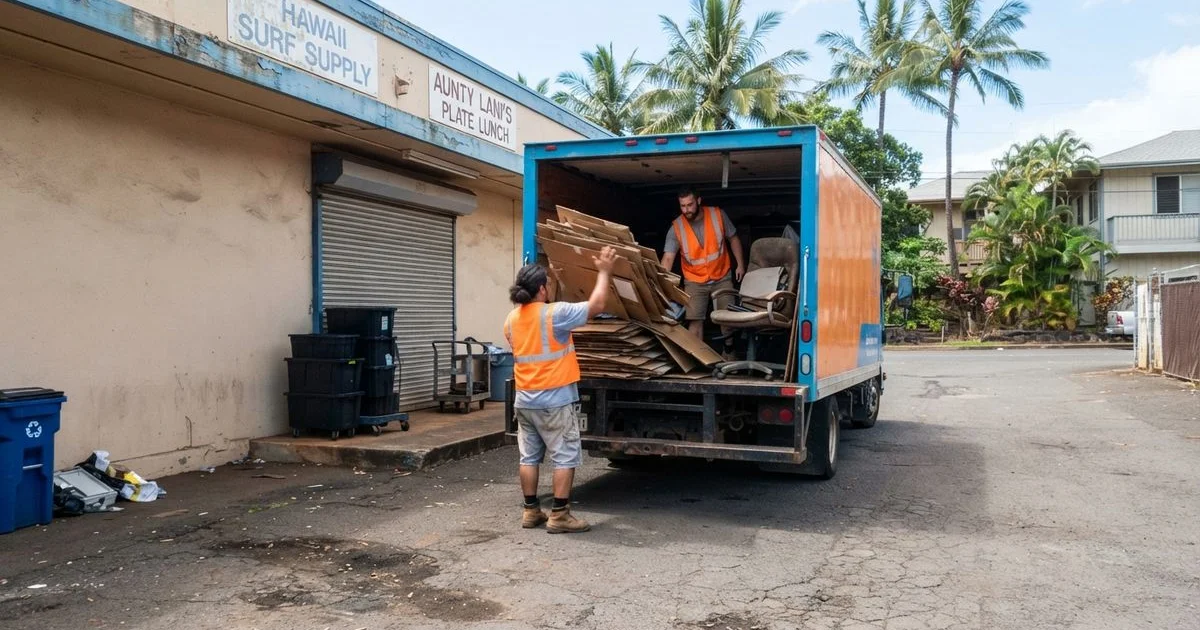
A junk removal job for a business rarely looks like a residential pickup scaled up. Office remodels, retail strip-outs, and warehouse cleanouts come with their own scheduling constraints, access requirements, and pricing patterns that are worth understanding before you request a quote.
How commercial jobs typically get quoted
Most commercial junk removal providers price by truck volume or by crew hours rather than a flat per-item rate, since the range of jobs, clearing a single office suite versus a full warehouse, is too wide for one pricing model to fit both. Larger cleanouts sometimes involve a dumpster rental left on site for a few days instead of a single truck visit, particularly for ongoing projects like a remodel or a phased move.
Get a written estimate based on a walkthrough or detailed photos rather than a rough phone guess, especially for anything beyond a single-room cleanout. Commercial volume is easy to underestimate over the phone, and a mismatch between estimate and reality is more disruptive for a business on a schedule than for a home.
Scheduling around business hours
Unlike a residential pickup, commercial jobs often need to work around operating hours, a loading dock’s availability, or a building’s freight elevator schedule. If your business needs work done outside normal hours to avoid disrupting customers or staff, say so when requesting a quote, since not every crew offers after-hours scheduling and it may affect pricing.
Coordination with a property manager matters more than people expect. Some buildings require advance notice for loading dock use or restrict after-hours access entirely. Confirming this before the job is booked avoids a crew showing up only to be turned away at the door.
What a typical job day looks like
A crew arrives with a truck sized for the estimated volume and confirms details with whoever is on site, an office manager, a contractor, or a property manager, before starting. For larger jobs, expect two or more crew members and a timeline of a few hours rather than one, particularly if the work involves navigating a freight elevator or moving through a busy building.
| Job type | Typical crew size | Typical timeline |
|---|---|---|
| Small office suite cleanout | 1 to 2 people | A few hours |
| Retail space strip-out | 2 to 3 people | Half a day to a full day |
| Full warehouse or building cleanout | 3 or more people, sometimes multiple visits | One to several days |
| Ongoing remodel debris pickups | Varies, often scheduled at set intervals | Recurring, weekly or per phase |
Questions worth asking before booking
Ask whether the company carries commercial liability insurance, since this matters more for business properties than most residential jobs. Ask how they handle recyclable materials, electronics, and metal, since some businesses have sustainability commitments or lease terms tied to waste diversion. And ask directly what happens if the job runs longer or bigger than estimated, an hourly add-on, a follow-up visit, or a renegotiated flat rate, so there are no surprises mid-job.
Building an ongoing relationship
If your business needs junk removal regularly, tenant turnovers, seasonal equipment changes, ongoing construction debris, it is often worth establishing a relationship with one provider rather than re-shopping every time. Recurring commercial clients frequently get more flexible scheduling and clearer, more consistent pricing once a provider understands the rhythm of your business.
Handling multi-tenant and shared buildings
Businesses in shared commercial buildings face an added wrinkle: coordinating with other tenants or a building association before scheduling a cleanout. If a loading dock or shared hallway is involved, other businesses in the building may need advance notice too, not just your own staff. A provider experienced in multi-tenant commercial work will often ask about this without being prompted, since it affects both scheduling and how carefully the crew needs to move through shared spaces.
It is also worth clarifying who is authorized to approve final pricing on site if the person requesting the quote will not be present for the actual pickup. Miscommunication here, an employee approving a change in scope without checking with a manager first, is a common source of billing disputes on commercial jobs that a short conversation upfront can prevent.
For more on how we evaluate commercial providers on responsiveness and reliability, see our methodology, or visit the home page to compare other categories relevant to your property.
FAQ
- How is commercial pricing different from residential?
- Commercial jobs are more often priced by truck volume or crew hours rather than a flat per-item rate, since office, retail, and warehouse cleanouts vary widely in scale. Larger jobs may also involve multiple visits or a dumpster rental instead of a single truck load.
- How far in advance should a business schedule a cleanout?
- For anything tied to a lease turnover, remodel, or move, book at least one to two weeks out if possible. Crews with commercial experience tend to fill their schedules faster than for smaller residential jobs.
- Do we need to coordinate with our building or property manager?
- Often yes, especially for loading dock access, freight elevator scheduling, or after-hours work in a shared building. Confirm this before the job is booked so the crew is not turned away on arrival.
- What if the job runs longer than expected?
- Ask upfront how a provider handles jobs that run past the estimated time or volume, whether that means an hourly add-on rate or a follow-up visit, so there is no surprise if a full office cleanout turns out bigger than expected.